Why Scholars Differ
[embed]https://www.youtube.com/watch?v=MHJ_vi-0HEI[/embed]
This was the first course I delivered in the UK in 2001, but it
is as relevant today as it was then, if not more.
I used to deliver this course over three months at
shariah college, so here I am going to condense it and give you an overview.
Why do we need to know why scholars differ?
This is an important topic. Usually we have questions regarding how we pray, and every year, as soon as Ramadan approaches, moon-sighting and moon-fighting begins. Why do we have these differences?
Differences in Legal Rulings
We will cover the differences in legal rulings (
fiqh) in the four Sunni schools of thought and what are the reasons behind the differences?
We will not cover differences in
aqeedah, which is a big topic in itself.
Part 1: What is
shariah and what is
fiqh and their characteristics?
Part 2: The origin of the four schools of thought.
Is it possible to have one opinion? Is it even healthy to have one opinion? Can we abolish differences and unify the
ummah under one way of understanding? You can judge. I will not dictate to you what to understand.
Preserving the Deen
The Prophet (peace be on him) in the
hadith said:
Allah Almighty will send for this ummah in the beginning of every century the one who will renew the deen for this ummah. (Sunan abi Dawood)
Allah the Almighty sends in the beginning of every century for this ummah somebody to renew the matters deen for them (Bayhaqi)
We have some discussion on the definition of century, and there are some differences, (some say 20, others say 30), but the majority agree that a century is a 100 years. It may not be precisely 100 years, but it signifies a long time-frame, after which Allah Almighty will send somebody, which might be a group of people, or different individuals in different places to rejuvenate the
deen. We have seen this happen throughout history, from the first century onwards.
Renewing the Deen - Recognising False Claims
The Prophet (peace be on him) said:
The best generation is my generation, then those who come after them, then those who come after them. (Bukhari)
This is an authentic narration and testimony that the best people from the
ummah are from the first three generations. So it is not a coincidence that the first three schools of thought and the four imams came in the first three generations.
The Four Schools of Fiqh
KEYPOINT: We need to understand that the acceptance that Allah Almighty has given to these schools. Of course we are not saying that they are infallible or
masum, (as no one other than the prophets are infallible and have ‘
isma), as all humans make mistakes. However overall, these three generations was when we had the establishment of the vast majority of our heritage.
We do not wish to live in the past, but in order to move to the future, we need to understand our heritage.
What is Shariah?
Ever since Bin Laden came onto the scene,
shariah has become a familiar word! Yet no one quite knows exactly what
shariah is.

Technical Definition of shariah
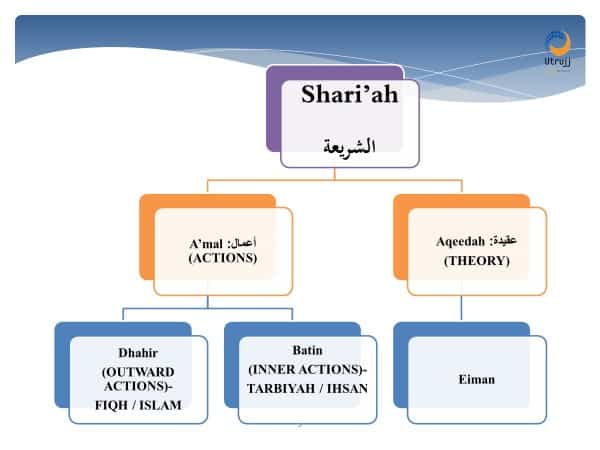
Shariah is comprised of two parts: action and theory.
Action
Within action we have the inward and outward actions.
The inward is
ihsan, which is explained in the famous
hadith Jibril.
Narrated by Abu Huraira:
One day while the Prophet (peace be on him) was sitting in the company of some people, (The angel) Gabriel came and asked, ‘What is faith?’ Allah's Messenger (peace be on him) replied, 'Faith is to believe in Allah, His angels, (the) meeting with Him, His Apostles, and to believe in Resurrection.’ Then he further asked, ‘What is Islam?’ Allah's Messenger (peace be on him) replied, ‘To worship Allah Alone and none else, to offer prayers perfectly to pay the compulsory charity (Zakat) and to observe fasts during the month of Ramadan.’ Then he further asked, ‘What is Ihsan (perfection)?’ Allah's Messenger (peace be on him) replied, ‘To worship Allah as if you see Him, and if you cannot achieve this state of devotion then you must consider that He is looking at you.’ (Bukhari)
The outward is the practical issues which are regulated by
fiqh.
Theory
The theory is the
aqeedah (belief) and
imaan (faith).
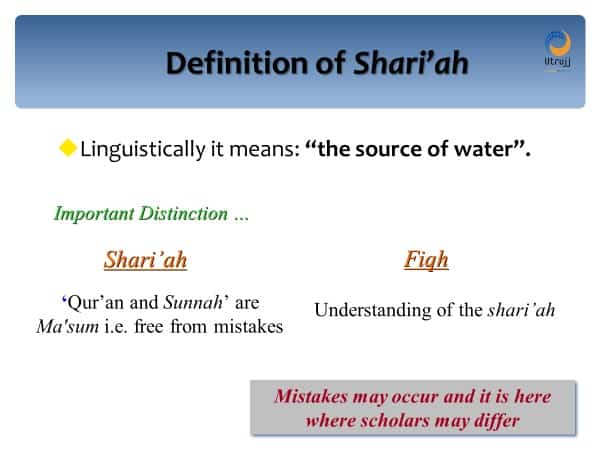
The linguistic definition is
shariah is from the root
sh-ra-aa, a source of water.
Shariah is the body of laws revealed through the Qur’an and
Sunnah. It is fixed and unchangeable. They are usually general principles.
Fiqh is the human understanding of
shariah. It tends to be specific and demonstrates the application of the basic principles of
shariah to given circumstances.
In other words,
fiqh is the deduction of Islamic laws from the
shariah, and covers situations that were not directly specified in the
shariah. This is where mistakes can happen. And also where laws can adapt to accommodate new issues.
We need to understand and distinguish between what is fallible and what is infallible. We should not treat what is infallible as fallible and vice versa. So when we talk about the renewal of the
deen, it is not a like a soup, which you put in all the ingredients and blend them together. Instead we have some components you can change and some which you can’t.
There are flexible issues and stable issues. The fixed issues are the foundations and the main principles, for example the inheritance system, which cannot be changed. By contrast, we now have new things like cryptocurrencies. Do we have the rulings to accommodate the new beast? Yes we do. The flexible issues are where we can have
ijtihad.
Cryptocurrencies
Fiqh
The definition of
fi qh
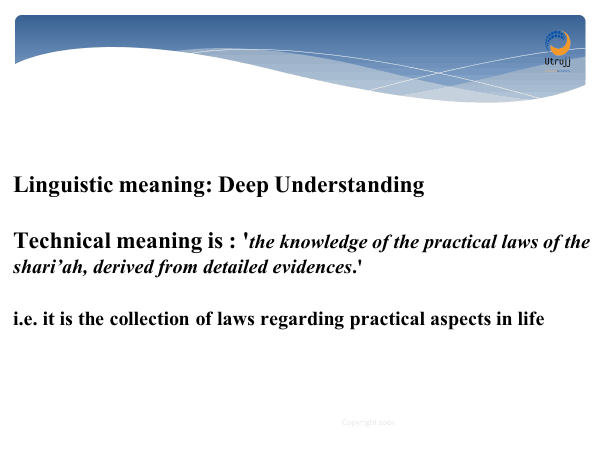
comes from the root
fa-qa-ha which means deep understanding. Allah Almighty says in the Qur’an so many times, e.g.
la alahum yafaqhoon, ‘they do not understand’, so Allah Almighty is referring to using your intellect. We were told:
Whoever Allah wishes good for, He gives deep understanding of the religion (Bukhari)
Fiqh is the deduction of Islamic laws from the
shariah and the person who determines the legal rulings is a
faqhi (i.e. jurist/ legal scholar) and the plural is
fuqaha.
The Technical Definition of Fiqh
The technical definition of
fiqh is very detailed and usually takes 4 hours to explain: 'The knowledge of the practical laws of the
shariah, derived from detailed evidences.' Basically it means the rules pertaining to
practical aspects of life, such as how to perform
salah, umrah and
hajj, give
zakat, carry out transactions, deal with parents etc.
It is not theoretical - they are covered by theology /
aqeedah and the spiritual is covered by
tarbiyaa (education and upbringing)
, tazkiyaa (purification) and
ihsan (excellence).
The message is three parts - in the middle we have practical aspects, on the right is the theological aspects, and on the left is the spiritual and character building aspects.

What are the Sources of Fiqh?
How did scholars come up with their opinions? Was it just their own efforts? Or was it based on principles?
Many people might think it was their own efforts and there is nothing to stop them doing the same. For any speciality there are principles which you have to learn. The door is open for those who are qualified and willing to come forward and dedicate time and effort to this speciality.
Agreed Sources
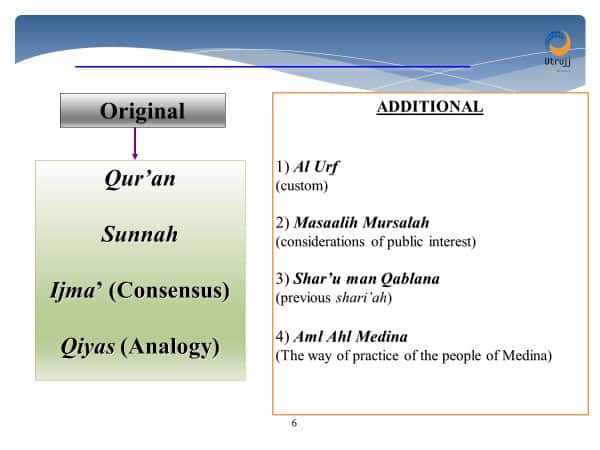
The four main sources are the Qur'an, the
Sunnah, Ijma (consensus) and
Qiyas (analogy). Even, the non-Sunni schools, such as the Shi'a have the Qur'an and
Sunnah, (although they do not call it
Sunnah, they call it the narrations of
ahlal bayt), and then they have consensus and intellect. Thus across the board these are the accepted sources: no one has any issue with the Qur'an, then you have the
Sunnah, Ijma which is the consensus of the scholars of the
ummah, (not the consensus of the general public, or like a new referendum on Brexit!).
The two columns are the components that are studied in
usool ul fiqh, the principles of
fiqh. Usool (basis) is another science in itself, separate from
fiqh (knowledge/jurisprudence).
Qiyas is a full science. It can be made by analogy between something that has been mentioned in the Qur'an and
Sunnah and something that is new. You compare them and based on that you form a ruling. For example, the prohibition of alcohol is stated clearly in the Qur'an, however nothing is mentioned in the Qur'an specifically about marijuana which some governments want to legalise. As intoxication is the reason behind the prohibition of alcohol, and as drugs are an intoxicant, they have the same ila (reason) so they share the same ruling.
Additional Sources
The additional sources are where discussion and disagreements happen. There are about ten additional practices, of which four are shown on the slide.
The first one is
Urf which is the usual custom in the community, such as whether goods are delivered as part of their sale or not, as this varies from country to country. The custom informs the ruling, so in countries where it is the norm to deliver the goods on sale, a judge would rule accordingly. Where it is not the custom, the buyer would have to pay extra for the delivery. Some schools do not rely on custom, others rely heavily on it, such as the Hanafi school.
The second one is
Masalah Mursala which is the consideration of public interest. This is mainly adopted by the Maliki school.
There are some rulings based not on Qur'an and
Sunnah but on public interest. For instance, in politics, is it the public interest to leave or to stay? If it is in the public interest you decided accordingly.
The third one is
Shar'u man Qablana or the earlier
shariah, which is a disagreed upon source. The Hanafi adopt this. For example, if we have no ruling in the Qur'an and
Sunnah but it was mentioned in the Bible and Torah, and it does not contradict our principles, can we rely on it? It is a point of disagreement, as some schools reject this, but the Hanafi adopt it with limits and conditions.
The fourth source is
Aml Ahl Madinah, or the practice of the people of Madinah which Imam Malik considers as a source of rulings, because the majority of the knowledge was disseminated in Madinah so he considered it source that could be relied on. There is more discussion and detail around this.
Later we see the rulings on issues vary depending on the sources the scholars relied on, then the outcome and rulings vary. Not because the
deen is different, but the sources used to decide issues was different. This is one of the main reasons for the differences between scholars.
What are the Rulings about learning Fiqh?
There are two types of knowledge - one which everyone needs to know, and the other which is specialised. These are categorised as
fard 'ain and
fard kifayah.
 Fard ain
is knowledge which every individual should have; you cannot delegate this knowledge to someone else, such as how to pray
salah. You cannot ask someone else to perform
salah on your behalf, as it is your responsibility. But if there is a
janaza in the community, which you could not attend, but someone else in the community did, this is
fard kifayah. Not everyone has to perform it, as long as someone does it. But we have no excuse for not knowing
fard ain.
If you work in currency exchange, you have to run your business according to
shariah, knowing what is
halal and
haram related to business and
riba. It is not an excuse to say you did not know what was
halal. Omar (may Allah be pleased with him) would be very stern if he went to the market and found business there who did not know how to run their businesses according to Islamic principles. He would quiz them and if they didn't pass, he would be angry with them. You have to learn what is relevant to your trade; it is not a luxury. If it is not your business, then it is not incumbent on you to know that. If you are a surgeon, and you leave your patient in the middle of an operation to pray, and he dies, then what kind of Muslim are you?! It would have been better for you to combine your
salah.
We need to improve our knowledge and know what is
fard ain and what is not.
There are many people suffering because they do not take
mortgages and become homeless. You need to know the basics which affect your life - as a spouse, parent, or son/daughter etc.
 What are the Characteristics of Fiqh?
Divine
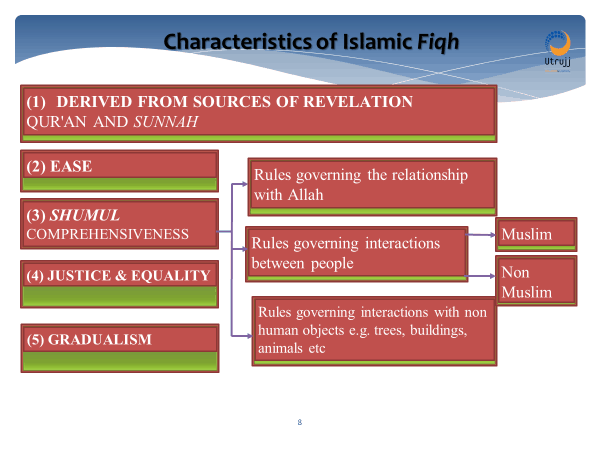
One of the characteristics of Islamic
fiqh, briefly, is that it is not human, but divine. Islamic law relies on a divine source - the Qur'an and
Sunnah. Both are classified as revelation.
The Qur'an is the recited revelation and in addition, the
Sunnah, is considered 'non-recited revelation'
al wahi ghayru matlu. Though we recite Qur'an in our
salah but we do not recite
Sunnah in our
salah. The Qur'an and
Sunnah are the main source of
fiqh.
Ease
Another characteristic of
fiqh is ease. So forget about the opinions and schools who try to make your life hell but telling you it is better to stick to the toughest, strictest opinions as they are closest to
taqwa. The Prophet (peace be on him) in countless authentic narrations, from Bukhari and Muslim would always choose the easiest of two choices as long as it was not a sin. So those who fill your mind with difficulties are making life miserable for no reason.
Comprehensiveness
It covers the minute details of the practical aspects of our life. From medical issues to new inventions such as drones. Are drones
halal or
haram? It depends what you use them for, if you use them to spy on someone, and invade their privacy, then it is
haram. So
fiqh tells you what is and isn't allowed. It covers relationship with people and with Allah Almighty. How to deal with the environment and inanimate objects. The Prophet (peace be on him) cared about the environment, and whenever he sent troops warned them not to chop down trees,, and look after the environment. He urged them to conserve resources, and not to kill birds without the intention that you would eat them 1400 years ago.
Justice and Equality
Islam does not have different rules for different people. The laws are applicable equally to all and there is no class, or race or colour that is superior to anyone else.
Gradualism
Tadaruj or gradualism is seen across the Qur'an and
Sunnah, as Allah Almighty brought in changes bit by bit. It is very important. You cannot suddenly make people practice Islam 100% overnight. Change was never brought in over night. There is no such thing as an Islamic revolution, where you wake up one morning and are told you have to practice Islam in an Islamic State, it would only be a disaster. Rather we need to teach people so they can embrace the change at their own pace. This is the virtuous circle in Utrujj, you need to learn and understand, then love it and then live it. We cannot live Islam without learning it, without understanding it or loving it. It does not work like that. We need to educate people and then they will love it and practice it. You don't need to force it on them. They will do it because they love it.
The prohibition of alcohol did not occur in Makkah, it was much later, in the last three years of the Prophet's (peace be on him) life that it was enforced, which means it took 20 years for the Muslims to reach that level where they could make such a big change in their lives, and Allah staggered this prohibition for them over four commands. Similarly
riba (interest) was one of the last things to be prohibited and this was not done over night, but over four stages, and concluded
Love is not an exclusive property of Valentine's Day. It is a crucial part of our
deen. Love to Allah and His Messenger and to deliver good to people around you. The culture of love is one we shun away from, but we need love in our life. We need to learn how to express our love within limits.
Divisions of Islamic Fiqh
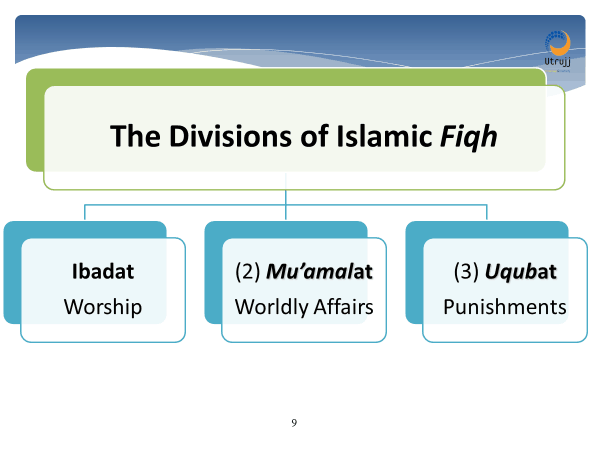
Scholars divided
fiqh into three categories:
Ibadat (worship, such as
salah, siyyam wudu),
mumamalat (transactions, sales, contracts) and then
uqubat (punishment).
We do not go into punishment because it is for the state, and we do not have any mechanism for punishment without a proper state. The West and non Muslims often want to understand Islam from its punishments – Islam is about chopping hands! This is completely wrong. You cannot take one screw out of a machine and define the machine by it. We are talking about a whole system, which works when it is all applied together. It will not work if you isolate parts of it. So you cannot understand Islam from its punishments. They are a full package, a full system.
The majority of
fiqh books talk about
ibadat. Perhaps two thirds or 40% of
fiqh books and
hadith discuss
ibadat, and the rest is usually 20-30% about
mumalat. If you pose the question, why do we have more on
ibadat than
mumalat, particularly when
ibadat is limited -we don't have new
ibadat but we have new issues all the time, in transactions and worldly affairs? Why do we have for the limited too many, and for the unlimited limited? Because
ibadat is prescriptive. You need to know the details of the details. This is called
tawqifi (divine). It is prescriptive and has to be done properly.
This is why the Prophet (peace be on him) said:
Pray the way you have seen me pray. (Bukhari)
It is exact. No more, no less.
Whereas
mumalat change - times, challenges, needs and circumstances keep changing. So we have principles but only a few details. Allah Almighty wants us to live in ease. If had been restricted for all time, and prescribed 100%, it would have been impossible for us when times changed. It would be too stagnant. So He left it open to change and the perfection of the religion that it is ease within change.

Types of Islamic Ruling
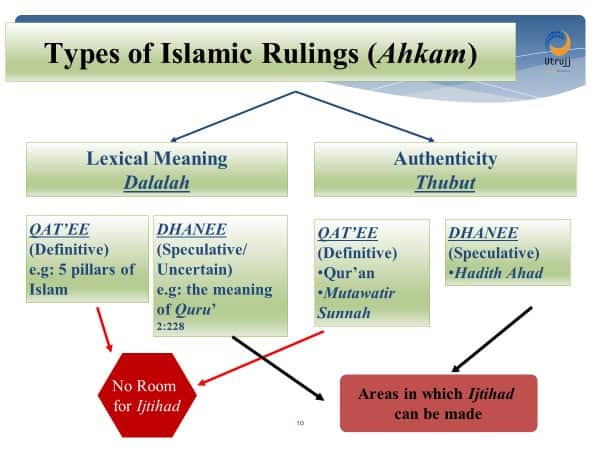
What are these types? We have a system on how scholars decide an issue. We have lexical meanings and authenticity. From a linguistic point of view an
ayah or a
hadith means something and we look at the context of what the companions understood when these were revealed. So we cannot now create new meanings from the words which is in conflict with how the companions understood it. It was their language and we cannot invent a new understanding. We need to understand the Arabic first, as they understood it.
Dalalah is the meaning. And
thubuut is where you received the news from.
Thabuut is the authenticity of the news. Is it fake or reliable?
When we quote something, we quote its source e.g. Bukhari because it reflects the authenticity of the source.
Sometimes authenticity is agreed, but we have a disagreement on the meaning, because the meaning is unclear.
Qatee is a definitive meaning. such as the five pillars of Islam cannot be reinterpreted, for example you couldn't say that they are the moon and sun.
Dhanee is a speculative meaning. The meaning is not entirely clear, for example, in the Qur'an Allah Almighty says:
And divorced women shall wait (as regards their marriage) for three quru. (2:228)
What is
quru? Quru can mean two different things - purity or menstruation. So you can't say 100% that the meaning of this
ayah is referring to purity or menstruation. The text yields multiple possibilities. So we have differences.
The highest level of authenticity is the Qur'an.
Some
Sunnah is also classified as the highest level of authenticity. If we have a doubt about authenticity, then we have differences.
When we have a text scholars put it through the lab tests. Is it definitive, or not?
The area of
ijitahad can be made in the speculative category. It cannot be made if the meaning or source is definitive. If someone is claiming they are renewing the
deen, but they are attacking a definitive area, you can tell that they are ignorant, if they have a good intention. Or they are deliberately corrupting the
deen.
So some matters are flexible and some are not.
Divisions of Hadith in Sunnah
We have 27 -30 types of
hadith and three main classifications of
hadith.
The words or actions of the Prophet can be authentic
(sahih) because of the chain of transmitters, some may have a weakness, but be good
(hasan), and if there is more weakness it is classified as weak
(da'if).
The Qur'an is
mutawatir which means it is beyond all doubt. The highest level of authenticity.
Mutawatir means a multitude of people received it and delivered the same message to a multitude of people, so there is no doubt that this a fact. For example, is there a doubt that America exists if you haven’t been there? It is
mutatwatir, because although you haven't seen it, a multitude has told a multitude about its existence.
The highest level within the
Sunnah is also
mutawatir which means it is like the Qur'an (not THE Qur'an). Not all the
Sunnah is
mutawatir. Only 313
hadith are
mutawatir. The majority of the rest of the
Sunnah is classified between
sahih and
hasan – with some accepted weak narrations with conditions. The rest have been filtered as to what is acceptable from them and what is not.
Don't misunderstand, if a
Sunnah is not
mutawatir it does not make it inauthentic.
Hadith Qudsi (also known as
hadith rabbani and
hadith ilahi) can belong to any category of authenticity- even weak or fabricated, but the difference is that they begin with 'Allah says..'
There are different types of
tafsir: linguistic like Zajaj, Zamakshari Qashaf, as well as
tafsir of
fiqh, where the scholars go through the
hadith and focus on the
fiqh issues,. When you read these, it is clear that the differences start in the early generations over certain
ayahs. Our late Shaykh Professor Zuhayli (rahim Allah) has written three tafsir books, one which is 15 volumes,
Tafsir Muneer, mainly on
fiqh issues. We rely on it heavily.
Course delivered by Shaykh Haytham Tamim on 2nd February 2019.
Related Posts
Why Scholars Differ - the Differences between the Schools of Thought
Why Scholars Differ -The Origin of the Four Schools of Thought
Defending the Sunnah
Why We Cannot Deny the Sunnah
Renewing the Deen - Recognising False Claims
The Four Schools of Fiqh

 qh comes from the root fa-qa-ha which means deep understanding. Allah Almighty says in the Qur’an so many times, e.g. la alahum yafaqhoon, ‘they do not understand’, so Allah Almighty is referring to using your intellect. We were told: